
Underground survival systems blueprint

Underground Survival Systems Blueprint

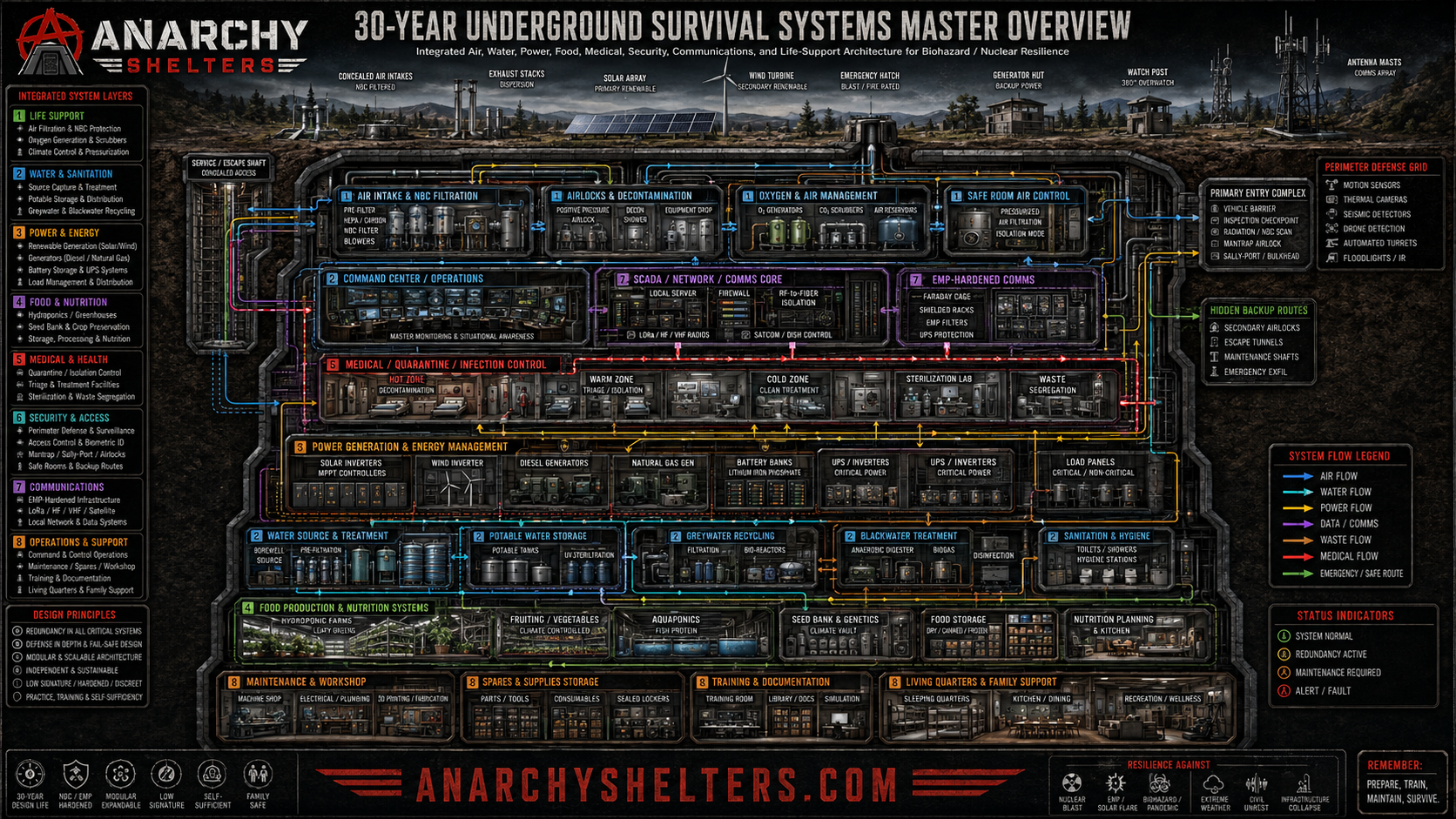
A master 30-year underground survival overview tying together air, water, power, food, medical, security, communications, operations, and hidden backup routes in one integrated hardened shelter architecture.

30-year underground survival systems master overview schematic
This master overview schematic shows the integrated shelter architecture: outside air intake and NBC filtration, command center operations, EMP-hardened communications, medical quarantine, power generation and UPS distribution, water treatment and sanitation, food production, training, living support, perimeter defense, and hidden emergency routes. Click the image to inspect it full screen.

Why the master overview matters

Most survival diagrams show one subsystem at a time. The master overview shows how the critical systems actually depend on one another over decades of operation.

  • Life support is tied to power, monitoring, alarms, and safe-room isolation.
  • Water, sanitation, food production, and medical functions are shown as connected operating systems instead of unrelated rooms.
  • Command, communications, and perimeter defense are integrated so the site can see, decide, isolate, and respond locally.

Air, life support, and decontamination

The top of the layout emphasizes that biohazard and nuclear survival begins with the air path and internal environmental control.

  • Air intake and NBC filtration protect against contamination before it enters the clean zone.
  • Airlocks, decontamination, oxygen generation or storage, CO2 handling, and safe-room air control enable sealed operation.
  • These systems must remain locally controllable even when the site is isolated from external infrastructure.

Command, communications, and EMP resilience

A shelter that cannot monitor conditions, communicate, and coordinate its own maintenance will degrade even if the shell is strong.

  • Command-center operations and SCADA / network control are central nervous system functions for the bunker.
  • RF-to-fiber isolation, shielded racks, LoRa, HF, local radios, and EMP-hardened communications reduce dependence on any one external path.
  • Hidden backup routes and emergency exfil support continuity if the primary entry or utility path is compromised.

Power, water, food, medical, and human sustainment

Long-duration operation is not only about surviving the initial event. It is about maintaining human life, hygiene, nutrition, and repair capability for years.

  • Power generation, battery banks, UPS protection, and critical/noncritical load separation keep the shelter stable.
  • Water source treatment, potable storage, greywater recycling, blackwater processing, sanitation, and hygiene support daily operation.
  • Food production, seed continuity, medical isolation, training, spares storage, workshop functions, and living quarters make the site sustainable instead of temporary.

Master-design principle: Every critical survival function needs redundancy, compartmentalization, maintainability, and a local-only operating mode. The overview is valuable because it shows the relationships between those systems instead of treating them as isolated components.

A 30-year underground survival systems master overview integrating air, water, power, food, medical, security, communications, and operations support in one hardened architecture.

Confidential first-contact systems assessment

Plan a master survival systems architecture

Describe occupancy, expected duration, target threats, desired subsystem depth, communications needs, power strategy, water source assumptions, and the construction method of the shelter.

Minimal information first. Your request has been received. We review shelter type, project phase, lawful-use requirements, communications needs, power constraints, and site-safety factors before recommending a path.
Desired systems