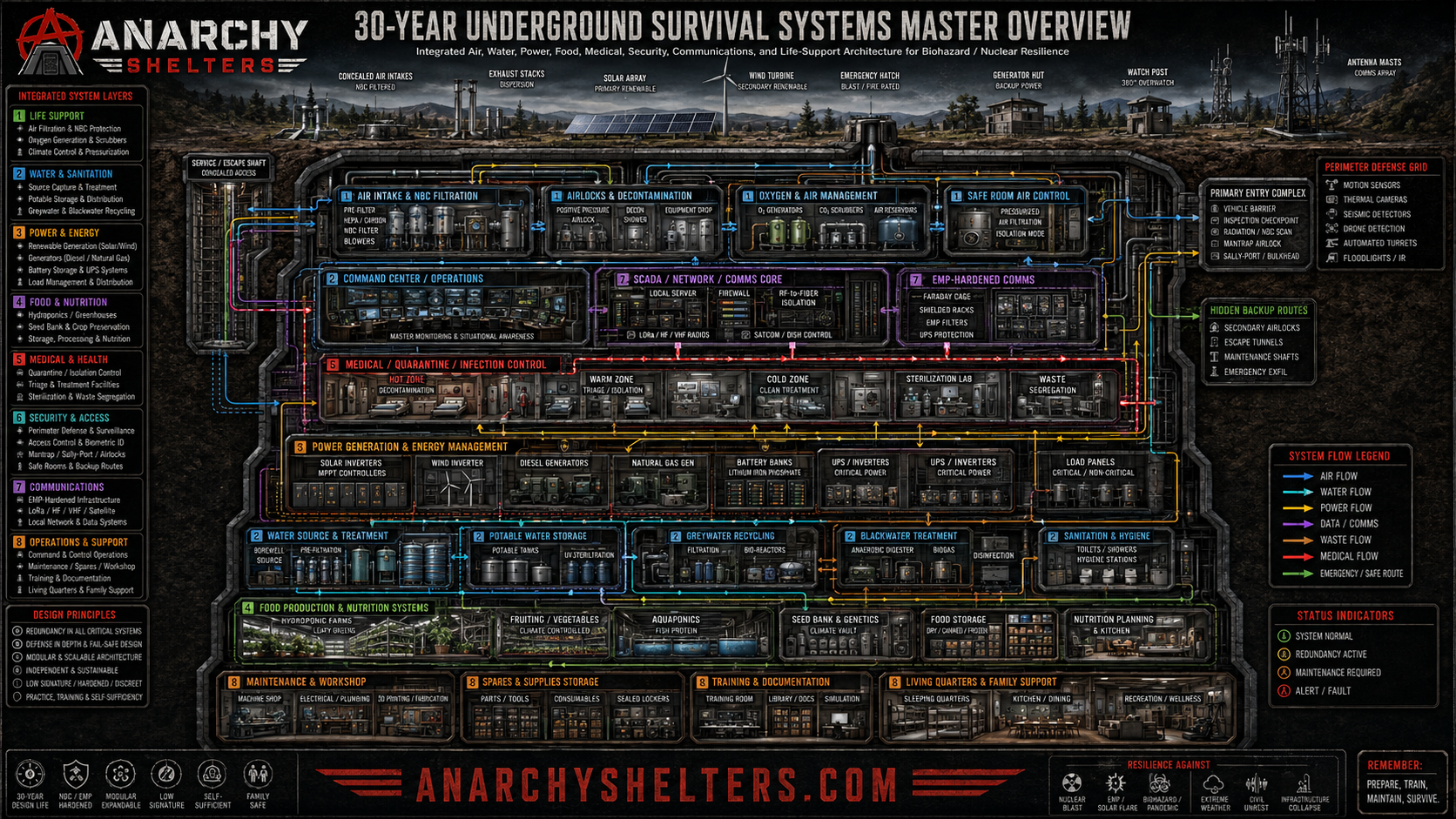
Protected envelope, blast-aware doors and hatches, penetrations, groundwater, buoyancy, waterproofing, and site-specific engineering coordination.
Risks addressed: Buoyancy, groundwater, progressive collapse, unprotected penetrations, and site-specific load assumptions.
View system
NBC filtration planning, positive pressure, blast valves, HEPA and activated carbon stages, overpressure valves, manual fallback, and airlock workflow.
Risks addressed: Contaminated intake, filter exhaustion, pressure loss, CO2 buildup, humidity, and unserviceable airflow paths.
View system
Shielded equipment zones, protected electronics inventory, Faraday-aware planning, bonding and grounding, surge protection, fiber, spare storage, and manual fallback.
Risks addressed: Conductive entry paths, unprotected electronics, false hardening claims, grounding errors, and loss of local control.
View system
Battery banks, inverters, charge controllers, generators, fuel maintenance, ventilation, critical loads, thermal management, and manual blackout procedures.
Risks addressed: Fuel degradation, battery aging, unmanaged loads, generator exhaust hazards, thermal instability, and no manual blackout procedure.
View system
Potable water, filtration, redundant pumps, manual water access, greywater, blackwater, waste isolation, backflow prevention, and sensor monitoring.
Risks addressed: Contaminated water, pump failure, backflow, unmanaged waste, hygiene collapse, and inaccessible maintenance points.
View system
LoRa telemetry, underground RF limits, surface repeaters, sensor mesh, shielded transitions, antenna placement, store-and-forward, and offline dashboards.
Risks addressed: Underground RF attenuation, overloading LoRa with high-bandwidth expectations, antenna exposure, cloud dependency, and untested relay paths.
View system
Local dashboard concept, shelter status, air pressure, CO2, humidity, power, battery, fuel, water, waste, filter state, door state, sensor alerts, logs, and manual checklists.
Risks addressed: Cloud dependency, hidden alarms, no manual gauges, no checklists, poor operator handoff, and dashboard overconfidence.
View system
Isolation bay, infection-control workflow, clean and contaminated zones, PPE, pressure planning, medical storage, triage, waste, sanitation, and redundant lighting/power.
Risks addressed: Cross-contamination, unclear zone transitions, inadequate PPE storage, waste mishandling, no command communications, and psychological strain.
View system
Food storage, calories, macronutrients, micronutrients, rotation, freeze-dried/canned/dry goods, seed bank, controlled growing, water and power load, inventory, and morale.
Risks addressed: Calorie shortfall, micronutrient gaps, mold, pests, crop failure, unrealistic hydroponics assumptions, water and lighting loads, and menu fatigue.
View system
Maintenance calendar, corrosion control, cathodic protection concepts, waterproofing checks, pump/generator tests, fuel polishing, battery cycles, filter changes, sensors, spares, tools, binders, and drills.
Risks addressed: Install-and-ignore thinking, corrosion, stale fuel, dead batteries, clogged filters, drifted sensors, missing spares, lost vendor records, and untrained occupants.
View system
Planning and professional-review note
Information on this site is for planning and education. Underground shelters, electrical systems, ventilation, fuel storage, NBC filtration, EMP protection, water systems, waste systems, medical spaces, and life-safety systems require qualified professional design, permitting, installation, inspection, testing, and maintenance.
System packages include telemetry, command rooms, life-support, power hardening, food and water infrastructure, security layers, and managed support.