Local command and dashboard concept

Command Center / Operations Dashboard

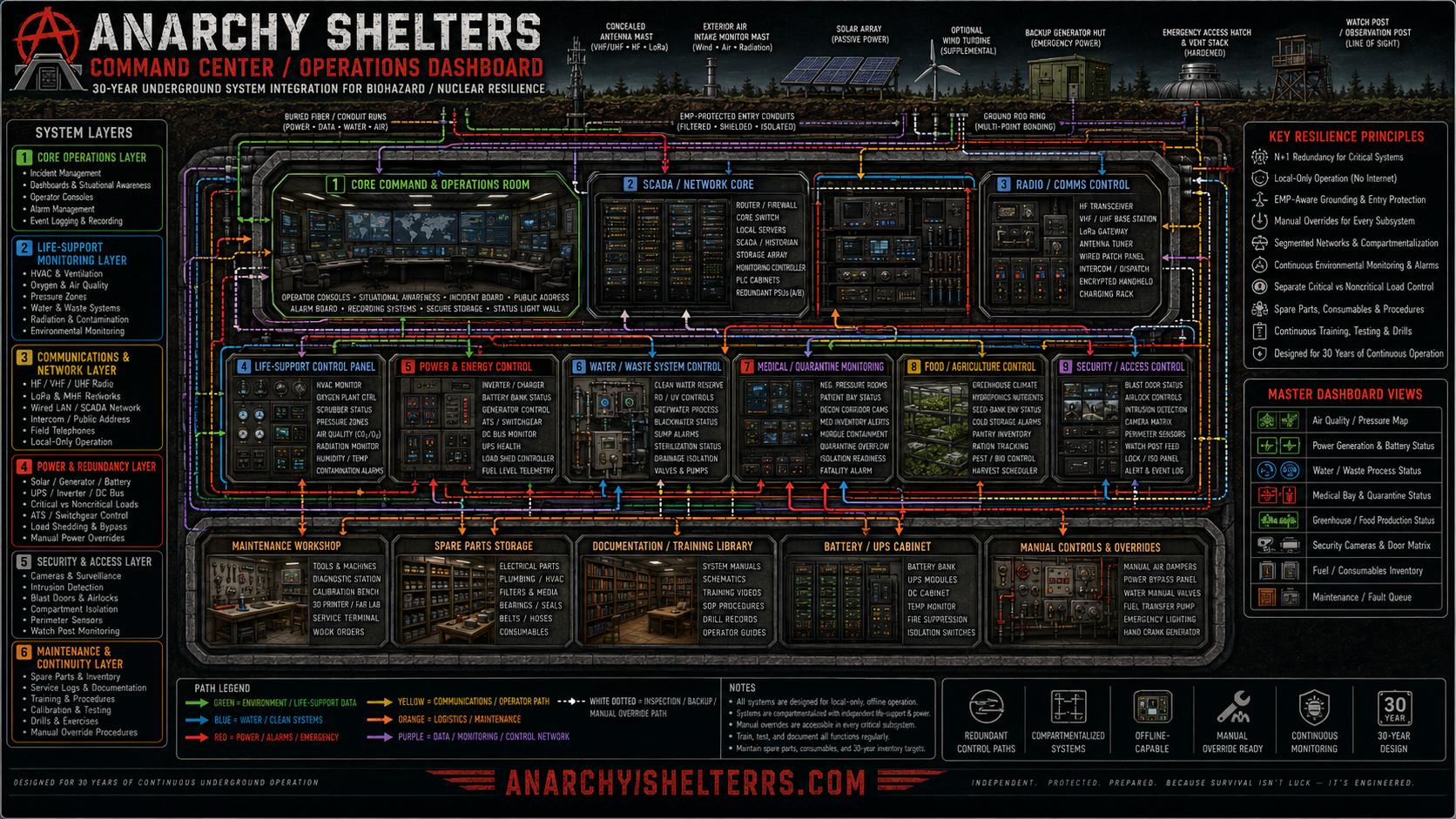
A local dashboard concept for shelter status, pressure, CO2, humidity, power reserve, battery state, fuel status, water storage, waste status, filter state, sensor alerts, logs, and checklists.

Command center operations dashboard schematic for underground shelter systems
The command center schematic shows local operations, SCADA/network core, radio control, life-support, power, water, medical, agriculture, access control, maintenance, and manual overrides. Click the image to inspect it full screen.

Dashboard concept / planning layer

System Role Planning Model
Control Mode Local-First
Review Boundary Professional Required
Fallback Priority Manual / Documented

Dashboard concept

The dashboard is not the system. It is the visibility layer.

  • The dashboard should summarize air pressure, CO2, humidity, power reserve, battery state, fuel status, water storage, waste status, temperature, filter status, door/hatch state, and sensor alerts.
  • It must work locally without cloud dependency for core shelter visibility.
  • It should support incident logs, maintenance reminders, and manual checklists.

Manual reality layer

A dashboard must not replace manual gauges, physical labels, paper procedures, and mechanical overrides.

  • Critical valves, breakers, dampers, doors, pumps, and transfer equipment need clear physical labeling.
  • Paper binders and local procedures should remain available when screens are dark.
  • Operator training should include no-network and no-dashboard scenarios.

Alarm and maintenance discipline

A command room should reduce confusion instead of creating more alerts.

  • Alarm priority levels, event logs, escalation paths, and false-alarm review.
  • Maintenance calendars for filters, batteries, fuel, sensors, pumps, generators, and communications equipment.
  • Role-based views for owners, operators, technicians, and builder/engineering teams.

Local-first integration

The dashboard coordinates systems without becoming a single point of failure.

  • Separate networks for life-safety, monitoring, communications, and administrative functions where appropriate.
  • Local logging, local server, backup power, and secure offline documentation.
  • Clear statement of what is monitored, what is conceptual, and what remains manual.

Confidential planning path

Need help mapping this system?

Start with a confidential systems assessment and identify the risks, dependencies, and maintenance requirements before selecting equipment.

Get a Custom Quote

Key planning questions

Questions to answer before design or procurement.

  1. Which systems must be visible locally?
  2. What is monitored versus manually checked?
  3. What alarms matter in the first five minutes?
  4. What logs must be kept?
  5. What still works when the dashboard is offline?
Planning and professional-review note

Information on this site is for planning and education. Underground shelters, electrical systems, ventilation, fuel storage, NBC filtration, EMP protection, water systems, waste systems, medical spaces, and life-safety systems require qualified professional design, permitting, installation, inspection, testing, and maintenance.

Local dashboard concepts for shelter status, air, power, water, waste, filters, doors, alerts, maintenance reminders, incident logs, and manual checklists.

Confidential first-contact systems assessment

Plan a shelter command dashboard

Share subsystem list, operator assumptions, required displays, manual controls, alarm priorities, log requirements, and whether this is a concept dashboard or installed monitoring layer.

Minimal information first. Your request has been received. We review shelter type, project phase, lawful-use requirements, communications needs, power constraints, and site-safety factors before recommending a path.
Desired systems