Protected Spaces Need Infrastructure That Still Works Offline
Anarchy Shelters helps builders, property owners, and continuity teams design, deploy, document, monitor, and maintain the communications, telemetry, power, and technical systems inside hardened spaces.
Underground bunkers
Blast-resistant safe rooms
NBC air filtration
Off-grid power and battery systems
Water, waste, and long-duration storage planning
Private consultation and discreet project handling
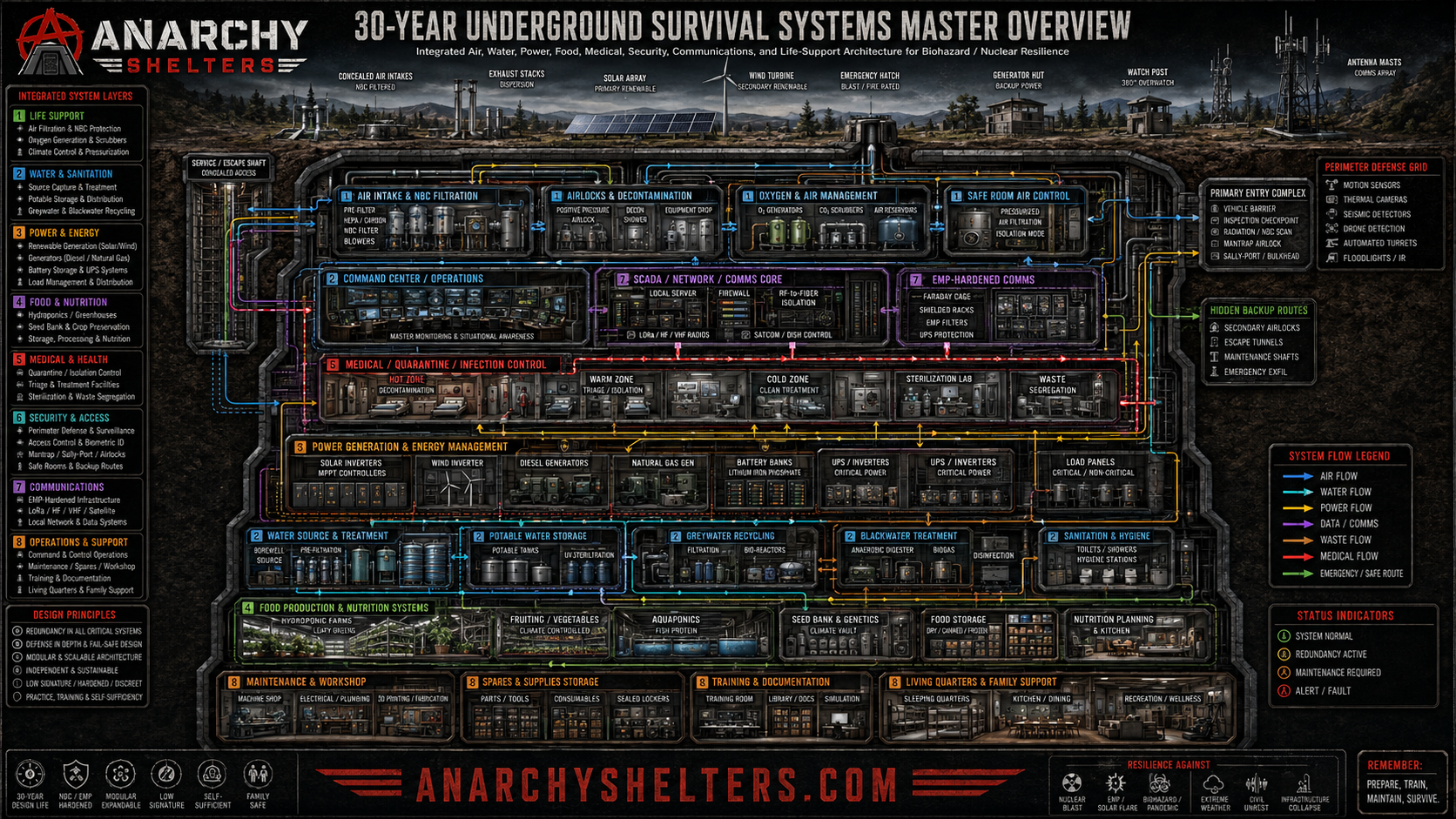
Conceptual systems overview: air, water, power, food, medical, security, communications, and operations support. Click the image to inspect it full screen.
Managed technical layer
The shelter shell is only one layer.
We focus on lawful-use review, site-specific engineering coordination, documented commissioning, managed shelter communications, LoRa telemetry, off-grid power visibility, penetration planning, and long-term support.
Lawful-use reviewEngineering coordinationCommissioning binderLong-term support
Common failure pattern
Many shelters fail because technical systems are added too late.
No planned conduit or service access
Poorly sealed penetrations and casual antenna cables
No power budget, dashboard, spare strategy, or monitoring plan
No commissioning binder, annual recommissioning, or humidity and condensation planning
Anarchy Shelters solution layer
We define the technical layer before the build locks it out.
Shelter communications, LoRa telemetry, and sensor networks
Operator messaging, relay nodes, and local dashboards
Power budgets, equipment rooms, and penetration planning
Documentation, commissioning, recommissioning, and managed support
Entity clarification
Survival infrastructure for hardened spaces.
Anarchy Shelters designs and markets serious underground survival infrastructure: private bunkers, storm shelters, safe rooms, NBC filtration layouts, and off-grid resilience systems. This site is about hardened physical shelter systems, not animal adoption, temporary housing, political organizing, or entertainment lore.
Shelter supplies
Outfit the shelter without guessing.
Research NBC air, backup power, batteries, water filtration, sanitation, food reserves, medical supplies, communications, tools, spare parts, and maintenance gear from one supplies hub.
Plan before the shell, system, or builder package is locked.
The knowledge base covers shelter types, underground structures, earthbag and earthen systems, storm shelters, off-grid power, air and NBC filtration, communications, life safety, compliance, operations, and builder resources.
Start with the shelter type, then define the systems.
Each project path links to a technical planning page with responsible language, conversion-focused next steps, and no unsupported certification claims.
Underground Bunkers
Private underground survival shelters planned around structure, access, air, utilities, and long-duration operation.
Serious shelters are engineered systems, not holes in the ground.
A hardened shelter project can be specified with reinforced concrete, plate steel, blast-aware doors, protected penetrations, airlocks, overpressure systems, NBC filtration, redundant power, battery backup, water storage, waste isolation, emergency hatches, and fire, flood, and ventilation planning. Final specifications are always project-dependent and require professional review.
Start with minimal information. Expand only as planning requires.
Private shelter projects require careful communication and controlled disclosure. Our consultation process starts with minimal information and expands only as needed for planning, engineering, and compliance. Do not submit exact coordinates, security layouts, or private drawings in the first message.
Resource hub
Resources for Underground Shelter Planning
Lawful, safety-oriented planning resources for private shelters, emergency power, water storage, sanitation, off-grid communications, NBC air basics, and DIY risk education.
Shelter PlanningCivil Defense HistoryEmergency PowerWater Storage and FiltrationFood StorageCommunicationsMedical PreparednessSanitation and WasteNBC Filtration BasicsDIY Risk Education
Minimal first-contact disclosure, controlled communications, project-specific planning, and responsible confidentiality.
Read planning guideEducational use only.Resources are for general preparedness planning only and are not a substitute for licensed engineering, medical, legal, construction, or life-safety advice.
FAQ
Common questions before the first shelter consultation.
How long can a bunker support occupants?
Support duration depends on occupant count, air handling, water, waste, food, power, medical needs, maintenance, and design assumptions. Serious projects require system-by-system planning.
What is NBC filtration?
NBC means nuclear, biological, and chemical. In shelter planning it can involve protected intake, staged filtration, positive pressure, airlocks, valves, dampers, monitoring, and maintenance.
Can a bunker be connected to a basement?
Conceptually yes, but structure, egress, drainage, waterproofing, fire separation, air handling, and code constraints must be reviewed by qualified professionals.
How private is the consultation process?
The first contact asks for minimal information: general region, project type, occupant range, and goals. Sensitive site details should not be sent in the first message.
Do I need permits?
Permit requirements vary by jurisdiction. Final construction, code compliance, and inspections require local review and qualified professionals.
Can systems include solar and battery backup?
Yes. Project-dependent resilient power planning can include solar, battery banks, inverters, generators, critical-load panels, fuel planning, and manual fallback.
Can shelters include medical, food, or command modules?
Yes. Conceptual planning can include medical/quarantine areas, food storage and production, command rooms, communications, monitoring, and maintenance zones.
Can a bunker survive a direct nuclear strike?
No civilian shelter should be marketed as surviving every possible direct strike. Real survivability depends on distance, yield, soil, structure, overburden, blast load, fallout exposure, ventilation, and engineering review.
Private shelter consultation
Start With a Private Shelter Consultation
Map the bunker type, safe room needs, NBC air strategy, off-grid systems, utilities, privacy requirements, and professional review path before committing to expensive decisions.