Resilient power architecture

Power and Fuel Systems

Planning for redundant power, battery storage, inverters, charge controllers, generator support, fuel storage realities, thermal management, critical loads, and blackout procedures.

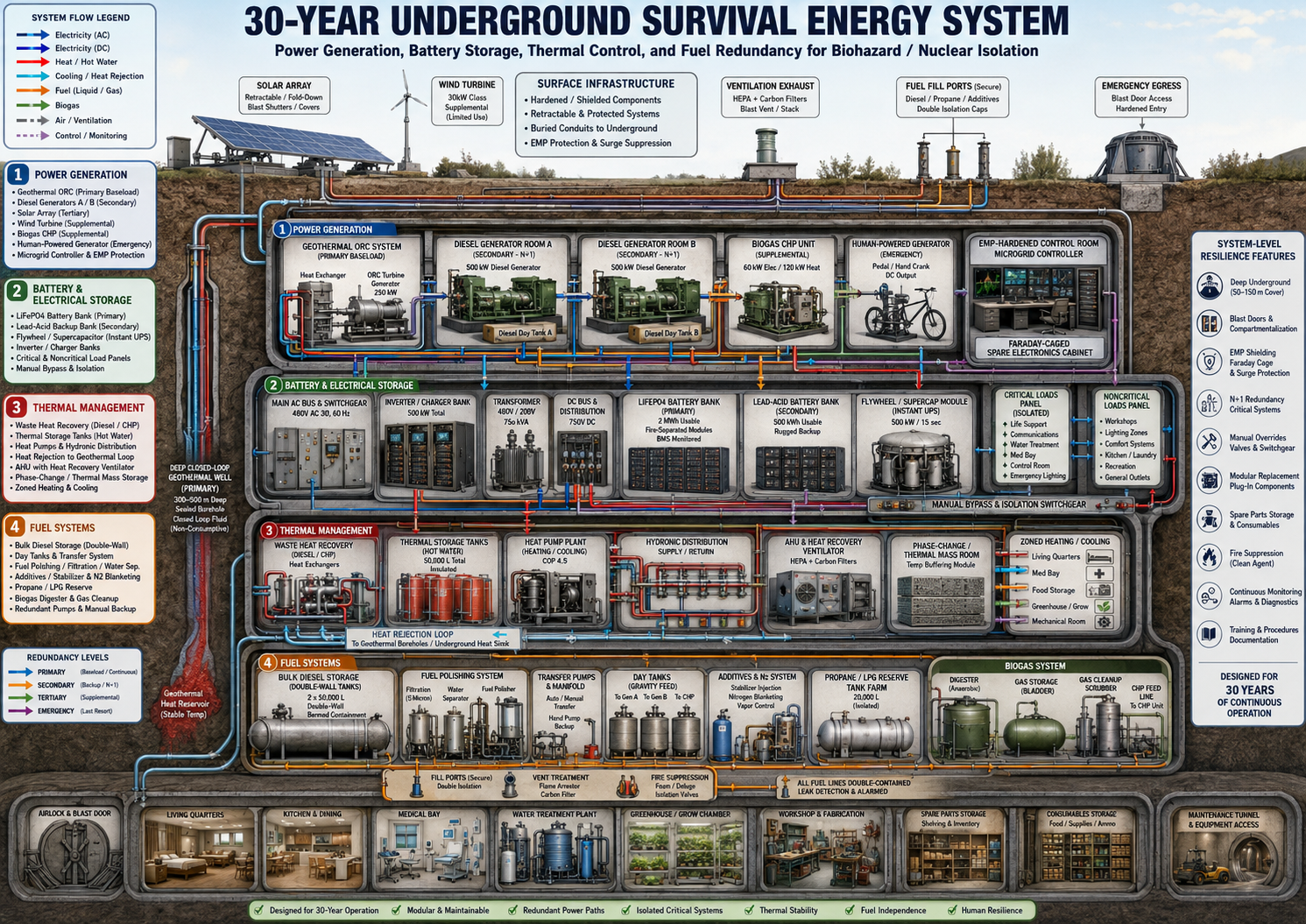
30-year underground survival energy system schematic
The survival energy schematic ties surface generation, deep backup sources, battery storage, protected distribution, thermal management, and fuel sustainment into a long-duration design. Click the image to inspect it full screen.

Dashboard concept / planning layer

System Role Planning Model
Control Mode Local-First
Review Boundary Professional Required
Fallback Priority Manual / Documented

Redundant power architecture

Shelter power must be designed around priority loads and controlled degradation, not only a large generator.

  • Battery banks, inverters, charge controllers, solar or renewable input, generator transfer, and UPS-backed controls.
  • Critical and noncritical load separation so life-support, command, water, communications, and security loads get priority.
  • Black-start and manual operation planning for total system outage scenarios.

Fuel storage realities

Long-duration power planning has to address fuel chemistry, not just tank size.

  • Diesel degradation, biodiesel limitations, fuel polishing, water separation, stabilization, and stored-fuel testing.
  • Ventilation, exhaust routing, fire safety, tank inspection, and local code review.
  • Generator exercising and maintenance schedules so the system is not discovered dead during an emergency.

Critical loads list

The first planning exercise is defining what cannot fail.

  • Air filtration and CO2 control, water pumps, medical refrigeration if applicable, and waste handling.
  • Communications, local command dashboard, lighting, security sensors, locks, and environmental monitoring.
  • Battery runtime and generator runtime modeled against realistic human occupancy and maintenance intervals.

Thermal and maintenance planning

Power systems produce heat and require service access.

  • Thermal management, heat rejection, equipment spacing, spare parts, and safe service paths.
  • Battery replacement cycles, inverter maintenance, generator fluids, filters, belts, and test logs.
  • Documented procedures for blackout, load shedding, fuel rotation, and safe restart.

Confidential planning path

Need help mapping this system?

Start with a confidential systems assessment and identify the risks, dependencies, and maintenance requirements before selecting equipment.

Get a Custom Quote

Key planning questions

Questions to answer before design or procurement.

  1. What are the critical loads?
  2. How long must the battery bank carry life-support?
  3. What fuel is stored and how is it maintained?
  4. How often will generators be exercised?
  5. What has a manual fallback if controls fail?
Planning and professional-review note

Information on this site is for planning and education. Underground shelters, electrical systems, ventilation, fuel storage, NBC filtration, EMP protection, water systems, waste systems, medical spaces, and life-safety systems require qualified professional design, permitting, installation, inspection, testing, and maintenance.

Redundant power, battery banks, inverters, charge controllers, generator planning, fuel storage realities, critical loads, and blackout procedures.

Confidential first-contact systems assessment

Build a resilient power plan

Share critical loads, autonomy targets, generator assumptions, fuel type, battery goals, ventilation constraints, and what must keep working during blackout mode.

Minimal information first. Your request has been received. We review shelter type, project phase, lawful-use requirements, communications needs, power constraints, and site-safety factors before recommending a path.
Desired systems