Underground Power Systems
Underground Power System Blueprint
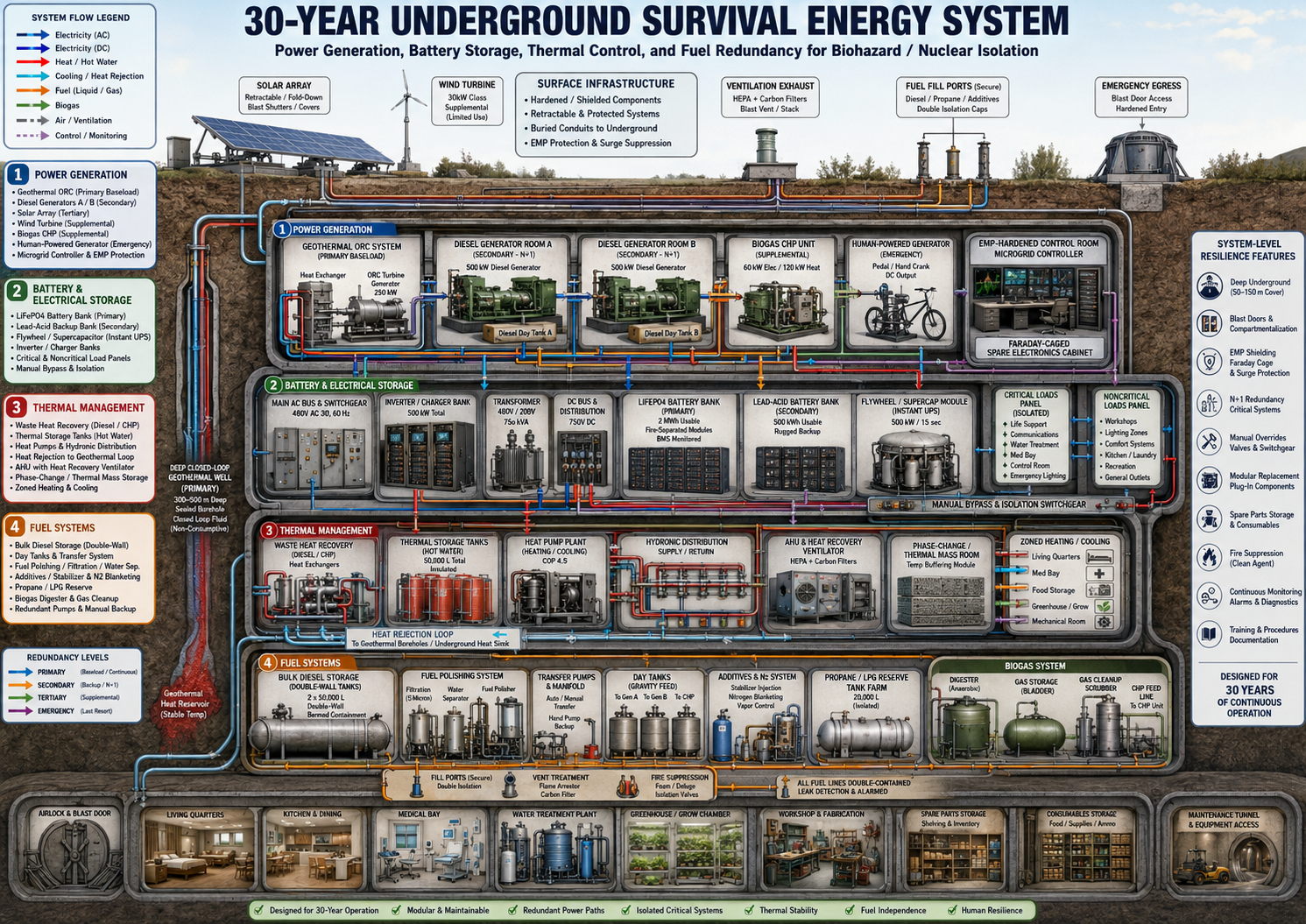
Critical-load budgeting, batteries, inverters, generator interface, safe fuel planning, ventilation, monitoring, and manual bypass.
Overview
Shelter equipment room and resilient property power planning.
Best use cases
Grid outage, generator failure, fuel degradation, battery failure, ventilation conflict, and critical-load overload.
Site and environment considerations
Protected utility room, generator outbuilding, battery room, or off-grid homestead support network.
Critical systems required
Interactive markers
Focus or hover any marker to understand the component.
Dynamic bill of materials
Grouped supply and system planning table.
Rows are mapped to categories that can resolve to WooCommerce product categories when available. Otherwise they stay commerce-ready for later product mapping.
Power
| Item | Priority | Purpose | Quantity / Duration | Supplies | Notes |
|---|---|---|---|---|---|
| Critical-load power budget | Critical | Prevents guessing about battery, inverter, generator, and runtime requirements. | One load list per system Update whenever equipment changes |
View Recommended Supplies |
Separate critical and non-critical circuits. Undersized power systems can disable air, water, or communications.
|
| Battery bank and battery monitor | Critical | Provides runtime buffer and visibility into state of charge. | Sized by load budget and autonomy goal Replace by chemistry and cycle life |
View Recommended Supplies |
Plan ventilation, thermal control, and fire risk. Batteries require proper installation and fire planning.
|
| Generator interface and fuel maintenance plan | High | Supports recharging and longer outages without unsafe backfeeding. | Project-specific Exercise and maintain fuel |
View Recommended Supplies |
Keep exhaust outside and away from air intakes. Carbon monoxide can kill quickly.
|
Lighting
| Item | Priority | Purpose | Quantity / Duration | Supplies | Notes |
|---|---|---|---|---|---|
| Low-power LED and task lighting | High | Maintains safe movement, maintenance, and medical work under low power. | By zone and task Entire sheltering period |
View Recommended Supplies | Include red/night mode where useful. |
| Headlamps and spare batteries | High | Keeps hands free during inspections and repairs. | One per occupant plus spares Rotate batteries |
View Recommended Supplies | Store where reachable in darkness. |
Monitoring
| Item | Priority | Purpose | Quantity / Duration | Supplies | Notes |
|---|---|---|---|---|---|
| Environmental sensor set | High | Tracks temperature, humidity, CO, CO2, pressure, smoke, leaks, water level, battery, and doors. | One set per monitored zone Continuous with calibration |
View Recommended Supplies |
Favor local display and logged history. Monitoring is not a substitute for inspection.
|
| Local dashboard and alert log | High | Turns sensors into operator decisions and maintenance actions. | One local dashboard plus paper log Continuous |
View Recommended Supplies | Keep offline procedures and manual overrides. |
Recommended supplies
Backup Power Bundle
Backup Power
Batteries, inverters, charge controllers, fuel maintenance, critical loads, generator monitoring, and safe ventilation planning.
Open supply categoryMonitoring Sensors
CO, CO2, humidity, temperature, leak, smoke, door, pressure, battery, water-level, and filter-status sensors.
Open supply categoryLighting
Low-power lighting, headlamps, emergency lighting, charging, batteries, night markers, and task lights.
Open supply categoryShelter Tools
Maintenance tools, inspection kits, fasteners, sealing supplies, labels, spare parts, and manual override support.
Open supply categoryCommunications
Hand-crank radios, local mesh concepts, LoRa-style telemetry, spare batteries, antennas, printed maps, and message templates.
Open supply categoryMaintenance notes
Power planning starts with loads, runtime, ventilation, heat, maintenance, and failure modes.
Safety notes
Fuel, generators, batteries, and electrical systems require qualified professional design and code compliance.
Blueprint FAQ
Questions to ask before buying supplies or locking a design.
Can I buy everything in this blueprint as one cart?
If WooCommerce bundles or mapped product categories are configured, the site can point to product categories or future bundle flows. Without WooCommerce, the page shows recommended supplies and a systems assessment path instead of fake checkout.
Is this a construction plan?
No. It is a planning and procurement map. Final construction, excavation, air, electrical, fuel, water, waste, and life-safety systems require qualified professionals.
How should I use the BOM?
Use it as a dependency checklist. Confirm what each system needs, what depends on power, what requires maintenance, and what needs professional review.
What is the most important system?
Air, water, power, waste, medical, communications, and monitoring all interact. The important step is mapping dependencies before the shell or equipment package is locked in.