Modular Steel Bunkers
Modular Steel Bunker Blueprint
A commerce-ready planning blueprint for modular steel shelters with air, power, water, dehumidification, and maintainability layers.
Overview
High-consideration residential, ranch, workshop, or compound projects that need professional structural, mechanical, and electrical coordination.
Best use cases
Long-duration shelter occupancy, severe weather, infrastructure failure, and private protected-space continuity.
Site and environment considerations
Excavated backyard, below workshop, below barn, drive-adjacent, or discreet utility-linked site with drainage review.
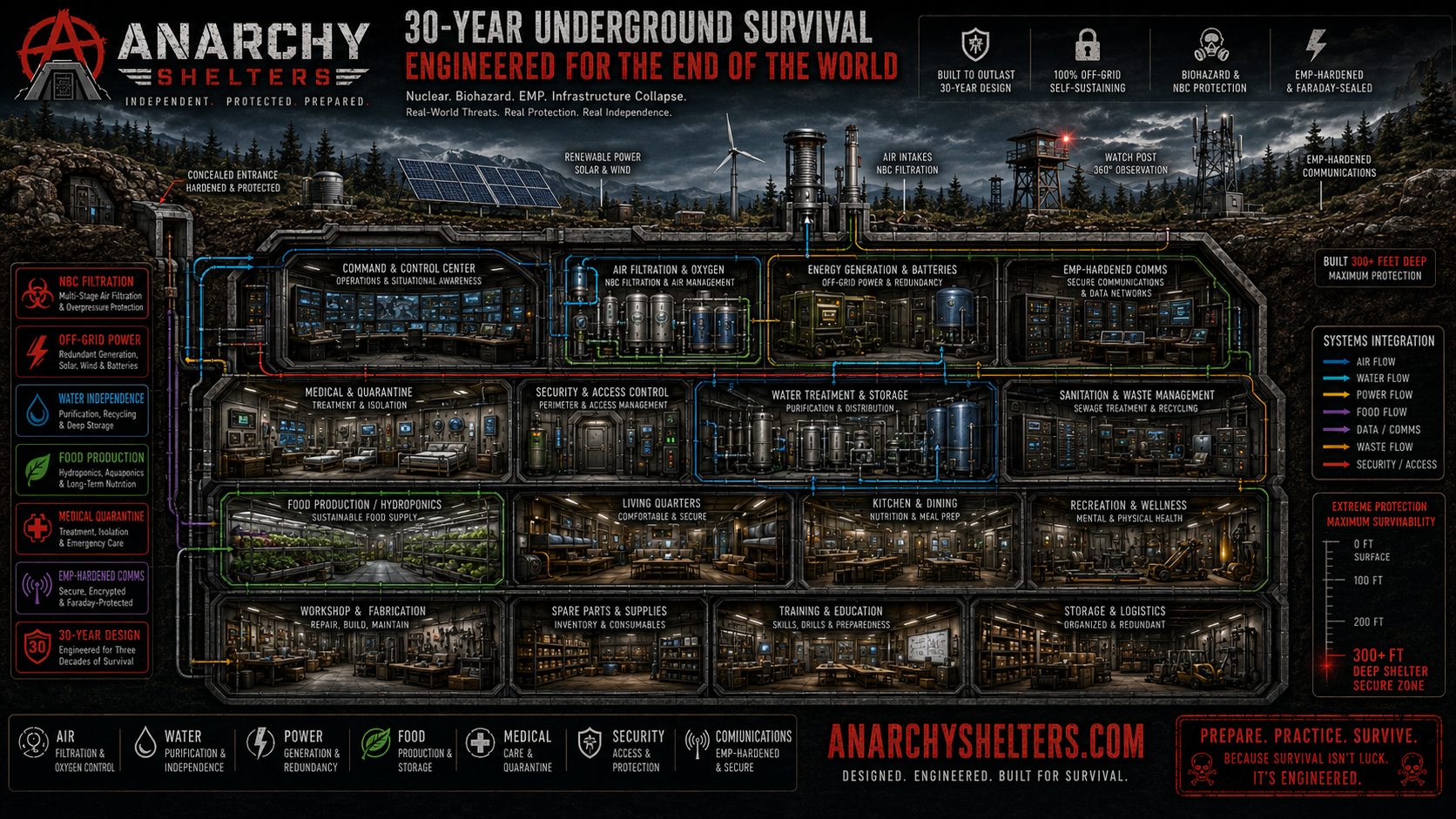
Critical systems required
Interactive markers
Focus or hover any marker to understand the component.
Dynamic bill of materials
Grouped supply and system planning table.
Rows are mapped to categories that can resolve to WooCommerce product categories when available. Otherwise they stay commerce-ready for later product mapping.
Air filtration
| Item | Priority | Purpose | Quantity / Duration | Supplies | Notes |
|---|---|---|---|---|---|
| Protected air intake planning | Critical | Defines where exterior air can enter without creating an uncontrolled weak point. | Project-specific Permanent system |
View Recommended Supplies |
Coordinate intake height, drainage, serviceability, shielding, and code review. Improper intakes can introduce contaminated air or water.
|
| Prefilter / HEPA / carbon filter categories | Critical | Creates staged filtration planning for dust, particulate, and vapor concerns. | At least one operating train plus spares Rotate by manufacturer and test schedule |
View Recommended Supplies |
Confirm actual certifications and pressure drop before purchase. Do not rely on untested filters for life safety.
|
Monitoring
| Item | Priority | Purpose | Quantity / Duration | Supplies | Notes |
|---|---|---|---|---|---|
| CO, CO2, humidity, and pressure sensors | Critical | Shows when occupancy, combustion, moisture, or pressure conditions become unsafe. | Multiple sensors in occupied and mechanical zones Continuous monitoring with calibration |
View Recommended Supplies |
Use local alerts and paper response procedures. Sensor failure must not be the only warning path.
|
| Environmental sensor set | High | Tracks temperature, humidity, CO, CO2, pressure, smoke, leaks, water level, battery, and doors. | One set per monitored zone Continuous with calibration |
View Recommended Supplies |
Favor local display and logged history. Monitoring is not a substitute for inspection.
|
| Local dashboard and alert log | High | Turns sensors into operator decisions and maintenance actions. | One local dashboard plus paper log Continuous |
View Recommended Supplies | Keep offline procedures and manual overrides. |
Water
| Item | Priority | Purpose | Quantity / Duration | Supplies | Notes |
|---|---|---|---|---|---|
| Potable water storage plan | Critical | Defines safe stored water and access when pumps or grid pressure fail. | Based on people, days, climate, and hygiene plan Rotate and test regularly |
View Recommended Supplies |
Separate potable and non-potable paths. Stored water can become unsafe without treatment and monitoring.
|
| Water purification and testing kit | Critical | Supports source water evaluation and treatment before use. | Primary plus backup method Maintain spares and test media |
View Recommended Supplies |
Use multiple barriers where possible. Do not assume clear water is safe.
|
| Manual pump or gravity fallback | High | Allows controlled water access during power loss. | One fallback path per critical water source Maintain and exercise |
View Recommended Supplies | Document operation with labels. |
Power
| Item | Priority | Purpose | Quantity / Duration | Supplies | Notes |
|---|---|---|---|---|---|
| Critical-load power budget | Critical | Prevents guessing about battery, inverter, generator, and runtime requirements. | One load list per system Update whenever equipment changes |
View Recommended Supplies |
Separate critical and non-critical circuits. Undersized power systems can disable air, water, or communications.
|
| Battery bank and battery monitor | Critical | Provides runtime buffer and visibility into state of charge. | Sized by load budget and autonomy goal Replace by chemistry and cycle life |
View Recommended Supplies |
Plan ventilation, thermal control, and fire risk. Batteries require proper installation and fire planning.
|
| Generator interface and fuel maintenance plan | High | Supports recharging and longer outages without unsafe backfeeding. | Project-specific Exercise and maintain fuel |
View Recommended Supplies |
Keep exhaust outside and away from air intakes. Carbon monoxide can kill quickly.
|
Tools
| Item | Priority | Purpose | Quantity / Duration | Supplies | Notes |
|---|---|---|---|---|---|
| Maintenance tool roll and labels | High | Supports inspection, tightening, replacement, sealing, and emergency work. | One maintained kit per shelter Inspect quarterly |
View Recommended Supplies | Match tools to installed equipment. |
| Spare seals, gaskets, clamps, and filters | High | Reduces downtime when common consumables fail. | By installed equipment Rotate and inspect |
View Recommended Supplies | Store in labeled bins with part numbers. |
Recommended supplies
Underground Bunker Kit
Air and Filtration
Filters, protected intakes, valves, pressure gauges, air-quality sensors, PPE storage, and maintenance spares.
Open supply categoryBackup Power
Batteries, inverters, charge controllers, fuel maintenance, critical loads, generator monitoring, and safe ventilation planning.
Open supply categoryWater Purification
Storage, prefilters, purification, testing, pumps, backflow prevention, greywater separation, and emergency taps.
Open supply categoryWaste and Sanitation
Waste segregation, hygiene, toilet supplies, PPE, cleaning, sludge handling, blackwater planning, and safe storage categories.
Open supply categoryMonitoring Sensors
CO, CO2, humidity, temperature, leak, smoke, door, pressure, battery, water-level, and filter-status sensors.
Open supply categoryShelter Tools
Maintenance tools, inspection kits, fasteners, sealing supplies, labels, spare parts, and manual override support.
Open supply categoryMaintenance notes
Steel shells still need drainage, corrosion control, cathodic protection review, inspection access, and condensation management.
Safety notes
Permanent below-grade steel structures require qualified structural, civil, electrical, mechanical, and code review.
Blueprint FAQ
Questions to ask before buying supplies or locking a design.
Can I buy everything in this blueprint as one cart?
If WooCommerce bundles or mapped product categories are configured, the site can point to product categories or future bundle flows. Without WooCommerce, the page shows recommended supplies and a systems assessment path instead of fake checkout.
Is this a construction plan?
No. It is a planning and procurement map. Final construction, excavation, air, electrical, fuel, water, waste, and life-safety systems require qualified professionals.
How should I use the BOM?
Use it as a dependency checklist. Confirm what each system needs, what depends on power, what requires maintenance, and what needs professional review.
What is the most important system?
Air, water, power, waste, medical, communications, and monitoring all interact. The important step is mapping dependencies before the shell or equipment package is locked in.