Local-first communications

LoRa and Off-Grid Communications

LoRa telemetry, surface repeater nodes, sensor mesh planning, shielded cable transitions, antenna placement, store-and-forward, offline dashboards, and no cloud dependency during emergencies.

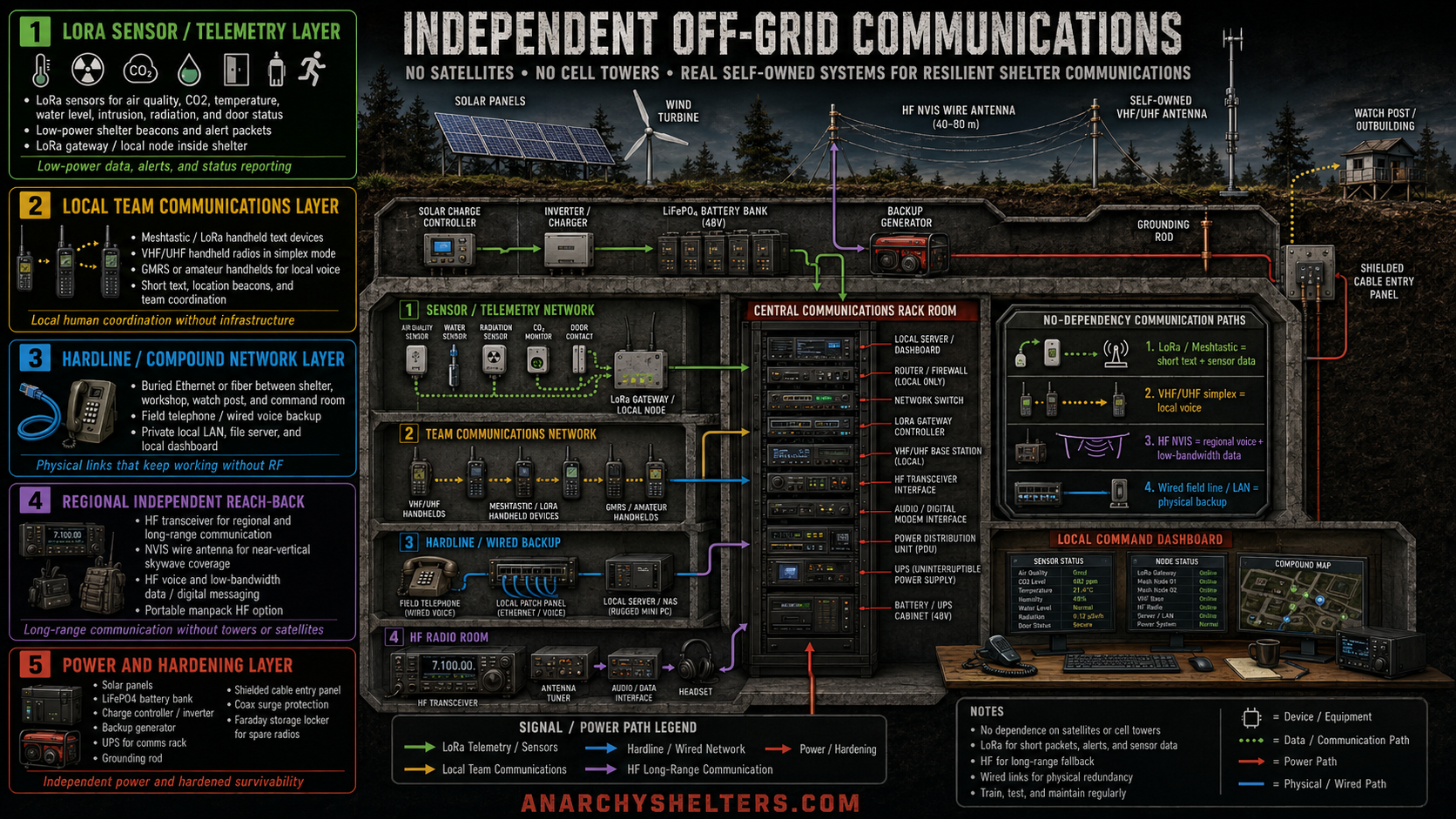
Independent off-grid communications architecture diagram for shelter systems
The communications schematic shows LoRa telemetry, local team communications, hardline backup, HF reach-back, a central rack room, and a local command dashboard. Click the image to inspect it full screen.

Dashboard concept / planning layer

System Role Planning Model
Control Mode Local-First
Review Boundary Professional Required
Fallback Priority Manual / Documented

LoRa telemetry role

LoRa is useful for low-bandwidth telemetry, not a replacement for high-bandwidth internet.

  • Sensor packets for air quality, CO2, temperature, humidity, water level, doors, batteries, pumps, and alarms.
  • Low power operation and store-and-forward concepts for sparse or remote nodes.
  • Offline dashboards that retain local visibility during internet or cloud outages.

RF limitations underground

Underground communication requires realistic expectations.

  • Soil, reinforced concrete, steel, terrain, antenna height, and tunnel geometry affect propagation.
  • Surface repeater nodes, mast placement, and shielded cable transitions may be required.
  • Commissioning tests should verify paths rather than trusting marketing range claims.

Local-first architecture

Emergency communications should not depend on a public cloud path.

  • Local gateways, local dashboards, local alerting, and documented manual procedures.
  • Separation between low-bandwidth telemetry, local voice, wired backup, and optional reach-back.
  • Shielded entry and EMP-resilient planning for antenna and cable paths.

Team communications and integration

Telemetry tells the shelter what is happening; operators still need human communication paths.

  • VHF/UHF, licensed options, HF, wired field phones, or other appropriate local coordination layers.
  • Local command dashboard integration for alarms, logs, sensor maps, and status summaries.
  • Legal and licensing review before any operational radio system is deployed.

Confidential planning path

Need help mapping this system?

Start with a confidential systems assessment and identify the risks, dependencies, and maintenance requirements before selecting equipment.

Get a Custom Quote

Key planning questions

Questions to answer before design or procurement.

  1. What must work without internet?
  2. Which sensors are local and which require surface nodes?
  3. What requires surface antennas?
  4. Which messages are low-bandwidth telemetry versus high-bandwidth data?
  5. What is the fallback if the radio path fails?
Planning and professional-review note

Information on this site is for planning and education. Underground shelters, electrical systems, ventilation, fuel storage, NBC filtration, EMP protection, water systems, waste systems, medical spaces, and life-safety systems require qualified professional design, permitting, installation, inspection, testing, and maintenance.

Local-first communications, LoRa telemetry, underground RF limitations, surface repeater nodes, sensor mesh, offline dashboards, and no cloud dependency.

Confidential first-contact systems assessment

Design a local-first communications plan

Share shelter count, terrain, sensor needs, building separation, antenna constraints, local team radio requirements, and whether regional or global reach-back is needed.

Minimal information first. Your request has been received. We review shelter type, project phase, lawful-use requirements, communications needs, power constraints, and site-safety factors before recommending a path.
Desired systems