
Food and nutrition resilience

Food, Storage, Seed Bank, and Nutrition

Long-term food storage, calorie planning, macro and micronutrients, rotation schedules, seed bank planning, controlled growing limits, inventory dashboard, ration planning, and morale.

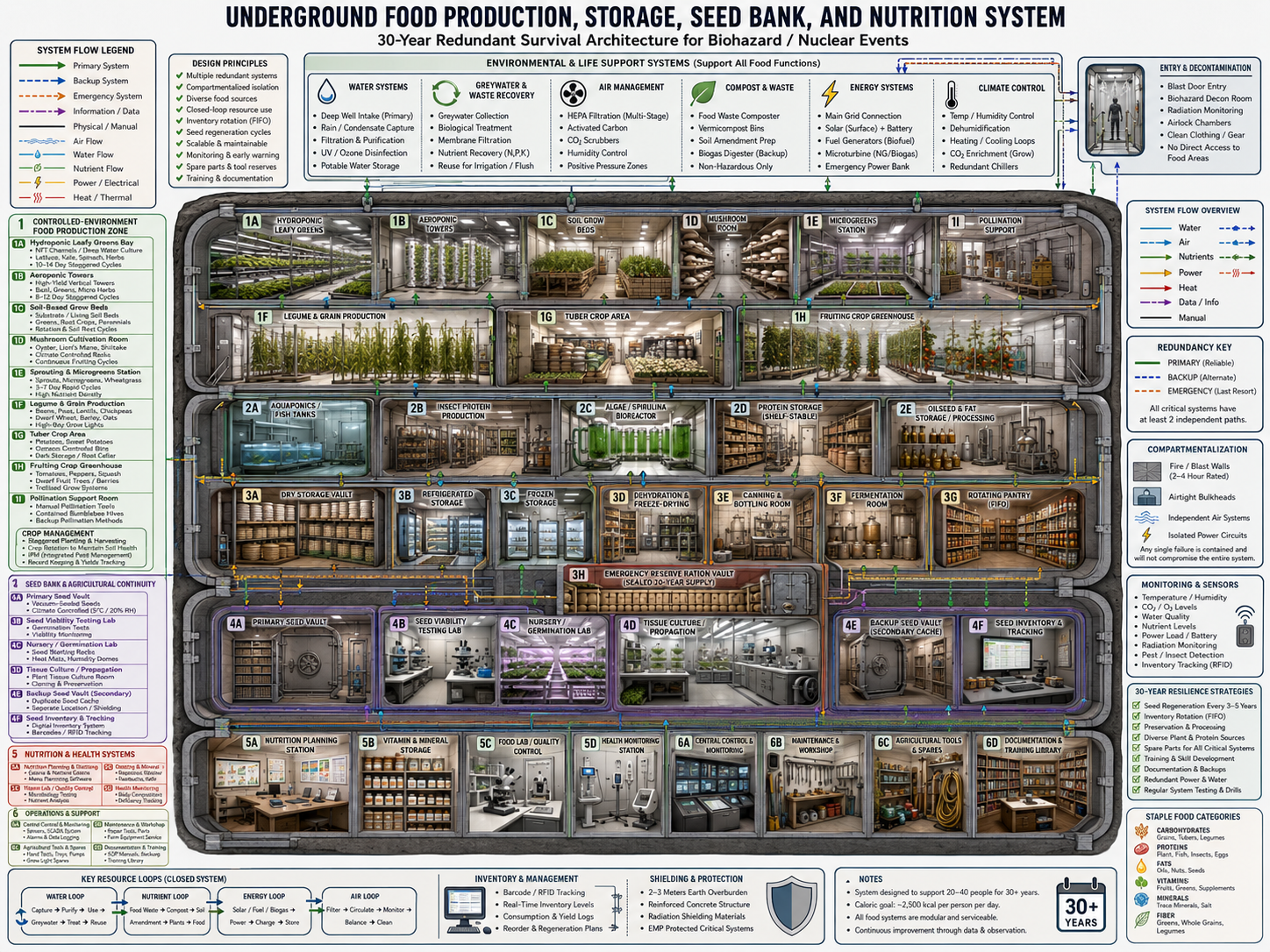
Underground food production storage seed bank and nutrition system schematic
The food and nutrition schematic maps controlled-environment growing, protein production, dry and cold storage, preservation, seed vaults, nutrition planning, and inventory control. Click the image to inspect it full screen.

Dashboard concept / planning layer

System Role Planning Model
Control Mode Local-First
Review Boundary Professional Required
Fallback Priority Manual / Documented

Stored food foundation

Long-term resilience starts with stable, inspectable, rotated food storage.

  • Freeze-dried, canned, dry bulk, preserved foods, oils/fats, salt, supplements, and comfort items.
  • Calorie planning, macronutrients, micronutrients, special diets, and menu fatigue.
  • Rotation schedules, inventory dashboard, pest control, humidity control, and spoilage inspection.

Seed bank and controlled growing

Hydroponics and controlled growing can help, but they are supplemental systems with real loads and dependencies.

  • Seed bank, germination planning, storage temperature, viability testing, and crop rotation.
  • Lighting load, water load, nutrient inputs, pollination, mold, pests, and sanitation.
  • Do not treat underground agriculture as magic food independence without energy, water, labor, and consumables.

Production diversity

A resilient food plan uses multiple food sources and production modes.

  • Greens, tubers, legumes, preserved food, protein storage, possible controlled grow areas, and backup reserves.
  • Active production paired with stored reserves so crop failures do not immediately become starvation events.
  • Food-prep workflow connected to water, sanitation, waste, and power planning.

Morale and documentation

People need sustainable routines, not only calories.

  • Ration planning, menu planning, meal preparation, morale foods, cooking energy, and shared schedules.
  • Documentation for inventory, expiration dates, regeneration, recipes, and training.
  • Clear assumptions about what is stored, what is produced, and what must be replenished.

Confidential planning path

Need help mapping this system?

Start with a confidential systems assessment and identify the risks, dependencies, and maintenance requirements before selecting equipment.

Get a Custom Quote

Key planning questions

Questions to answer before design or procurement.

  1. How many calories per person per day are planned?
  2. What macronutrient and micronutrient gaps exist?
  3. How is food rotated and inventoried?
  4. What water and power loads do grow systems require?
  5. How are mold, pests, and menu fatigue handled?
Planning and professional-review note

Information on this site is for planning and education. Underground shelters, electrical systems, ventilation, fuel storage, NBC filtration, EMP protection, water systems, waste systems, medical spaces, and life-safety systems require qualified professional design, permitting, installation, inspection, testing, and maintenance.

Long-term food storage, calories, macro and micronutrients, rotation, seed bank, controlled growing, inventory, ration planning, and morale.

Confidential first-contact systems assessment

Build a food resilience plan

Share occupancy, target duration, dietary needs, active grow goals, storage capacity, power/water limits, seed-bank goals, and inventory expectations.

Minimal information first. Your request has been received. We review shelter type, project phase, lawful-use requirements, communications needs, power constraints, and site-safety factors before recommending a path.
Desired systems