
Structural envelope planning

Structural Protection

Assessment and coordination support for the protected envelope, access points, groundwater risk, penetrations, drainage, and site-specific engineering review.

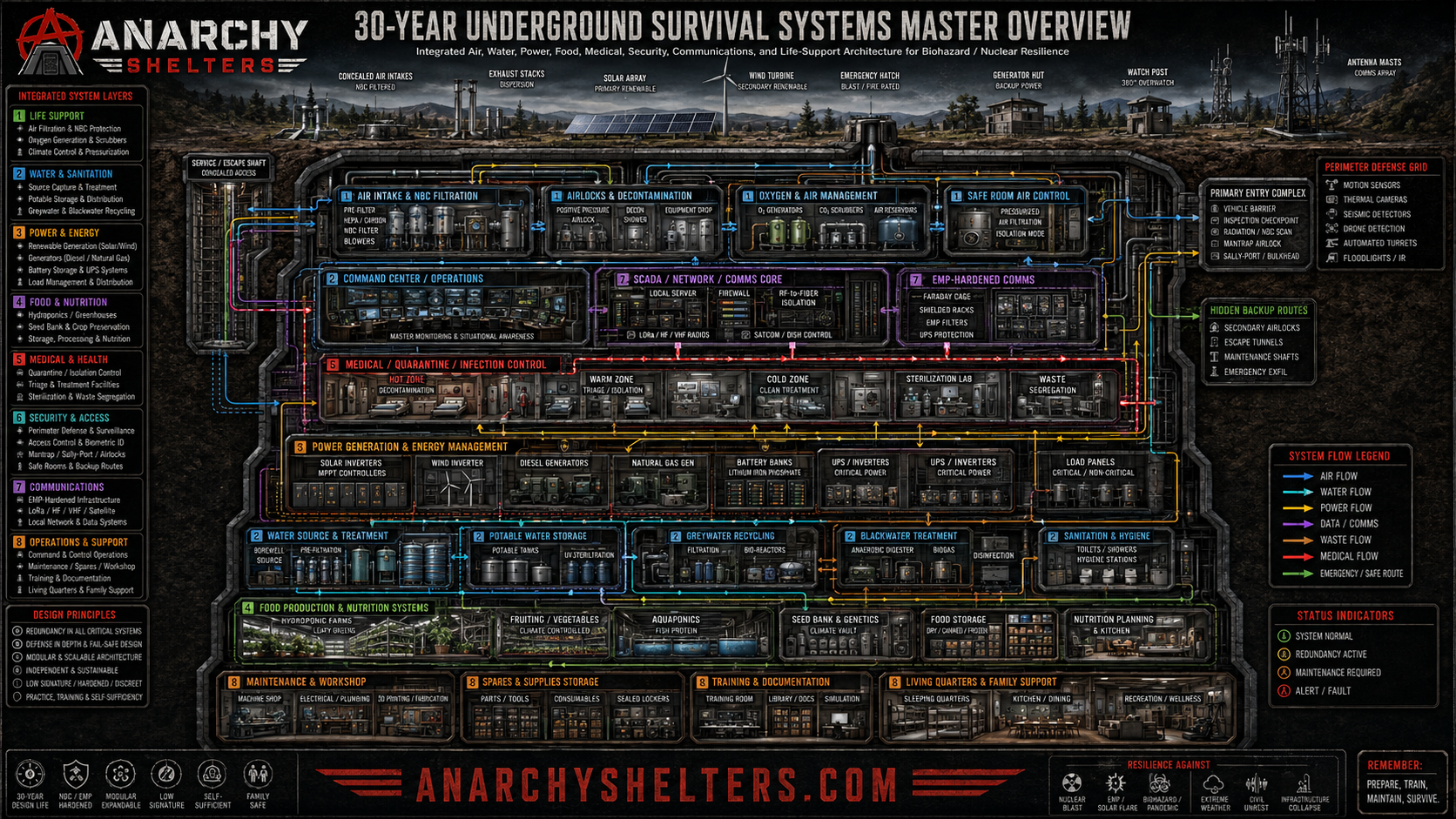
Master underground shelter systems blueprint showing structural envelope and integrated infrastructure zones
Structural protection planning starts with the full shelter envelope: entry paths, penetrations, water pressure, compartment boundaries, and maintainable access to critical systems. Click the image to inspect it full screen.

Dashboard concept / planning layer

System Role Planning Model
Control Mode Local-First
Review Boundary Professional Required
Fallback Priority Manual / Documented

Protected envelope concept

A shelter is not just a room underground. It is a protected envelope with defined boundaries, loads, penetrations, access controls, waterproofing, and service paths.

  • Blast-aware doors and hatches considered as part of the envelope, not decorative add-ons.
  • Reinforced penetrations for air, water, power, communications, drainage, and emergency egress.
  • Compartment boundaries and safe-room planning so one failure does not compromise the entire shelter.

Hydrology, buoyancy, and drainage

Groundwater and flood conditions can destroy an otherwise strong structure if uplift, hydrostatic pressure, drainage, and site grading are ignored.

  • Hydrostatic uplift and flotation risk review, including anchoring or deadmen concepts where appropriate.
  • Waterproofing, perimeter drainage, sump strategy, backflow prevention, and inspection access.
  • Site-specific civil and geotechnical review before treating any underground design as credible.

Progressive collapse awareness

A hardened shelter should be planned with redundancy and load-path thinking, not only surface-level wall thickness.

  • Structural continuity, ductility, and load redistribution are planning topics for licensed professionals.
  • Protected access vestibules and reinforced utility interfaces reduce single-point failure risk.
  • Safe-room and shelter guidance can inform the conversation, but does not replace project-specific engineering.

Professional review boundary

This page supports planning and requirements mapping only. It is not a construction manual.

  • Final structural, civil, waterproofing, ventilation, electrical, fuel, and life-safety designs require licensed professional review.
  • Permitting, inspection, local codes, and site-specific documentation must be handled by qualified teams.
  • No one-size-fits-all bunker design should be treated as safe across different sites and soils.

Confidential planning path

Need help mapping this system?

Start with a confidential systems assessment and identify the risks, dependencies, and maintenance requirements before selecting equipment.

Get a Custom Quote

Key planning questions

Questions to answer before design or procurement.

  1. What is the soil, water table, and flood history at the site?
  2. What structural system is planned or already built?
  3. Where do air, power, water, communications, and egress penetrate the protected envelope?
  4. How is buoyancy or flotation risk being addressed?
  5. What inspections and documentation will prove the envelope remains maintainable over time?
Planning and professional-review note

Information on this site is for planning and education. Underground shelters, electrical systems, ventilation, fuel storage, NBC filtration, EMP protection, water systems, waste systems, medical spaces, and life-safety systems require qualified professional design, permitting, installation, inspection, testing, and maintenance.

Protected envelope planning, hydrology, penetrations, access points, buoyancy, waterproofing, and site-specific engineering review.

Confidential first-contact systems assessment

Request a structural risk review

Share the construction method, site region, soil/water concerns, access design, envelope penetrations, and whether this is a new build or retrofit.

Minimal information first. Your request has been received. We review shelter type, project phase, lawful-use requirements, communications needs, power constraints, and site-safety factors before recommending a path.
Desired systems